dingbo@dieselgeneratortech.com
+86 134 8102 4441

- Home
- Products
- About Us
- Service
- News
- Technical Support
- Contact Us
dingbo@dieselgeneratortech.com
+86 134 8102 4441
Dec. 22, 2025
The muffler or silencer is a critical emission control and noise reduction component integrated into the exhaust system of a generator set. Often overlooked compared to the prime mover or alternator, its design and condition directly impact performance, regulatory compliance, and environmental footprint. Dingbo will tell you the internal structure, core functions, and operational significance of a generator set muffler.
A generator set converts chemical energy from fuel into electrical energy,a process that produces high-pressure, high-temperature exhaust gases from the engine's combustion cycles. If expelled directly, these gases generate excessive noise—a combination of pulsations from cylinder firing and turbulent flow—and carry harmful pollutants. The generator muffler is engineered to address both issues, serving as a passive device that conditions exhaust flow before its atmospheric release.
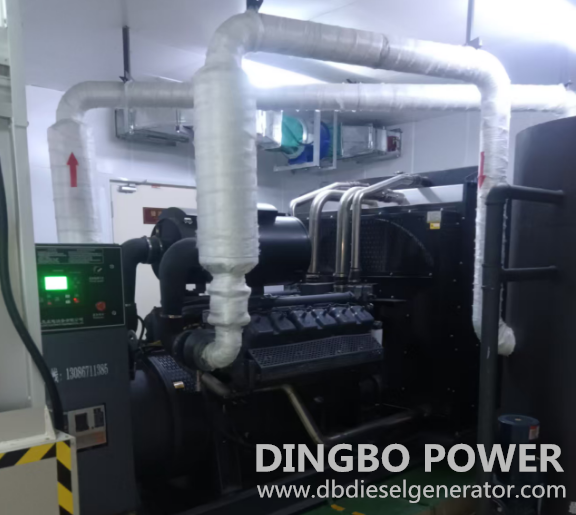
Modern generator set mufflers are typically cylindrical or oval chambers constructed from corrosion-resistant materials like stainless steel.Their internal structure is designed to attenuate sound energy through a combination of acoustic principles. Common designs include:
* Chambered or baffle design: The most common type for industrial generators. It features a series of internal perforated tubes and baffles (partitions) that create multiple expansion chambers. As exhaust pulses enter each chamber, they expand, causing sound waves to collide with each other and with chamber walls. This reflection and interference dissipates acoustic energy as heat, effectively reducing sound pressure levels, particularly in the low to mid-frequency range crucial for engine noise.
* Absorptive or straight-through design: Often used where backpressure is a critical concern. A perforated tube runs through the center of the canister, surrounded by a packing of high-temperature sound-absorbing material such as fiberglass or mineral wool. High-frequency sound waves pass through the perforations and are dampened by the absorbent material, while gases flow with minimal restriction. This design offers less low-frequency attenuation but superior flow characteristics.
* Resonator (Helmholtz) design: Sometimes used as a supplementary component. It consists of a specific volume of air connected to the exhaust stream via a narrow neck. It is tuned to cancel out a specific, problematic frequency by creating sound waves 180 degrees out of phase with the offending frequency, causing destructive interference.
Many industrial mufflers are reactive-absorptive hybrids, combining chambers and absorptive packing to achieve broad-spectrum noise reduction.
The muffler's role extends beyond mere noise suppression:
* Noise attenuation (primary function): It reduces exhaust noise to meet local environmental regulations, workplace safety standards (e.g., OSHA), and community nuisance guidelines. Proper sizing and selection are essential to achieve the required dB(A) reduction without compromising engine performance.
* Emission gas dispersion and spark arrest: The muffler provides a controlled exit point for exhaust. Its internal structure helps cool gases and can be designed to incorporate a spark arrestor screen, a critical safety feature for units operating near combustible materials, preventing hot carbon particles from escaping.
* Backpressure management: This is a critical design balance. While necessary for noise control, excessive backpressure—caused by an undersized, damaged, or clogged muffler—reduces engine efficiency. It forces the engine to work harder to expel gases, increasing fuel consumption, elevating operating temperatures, and potentially reducing power output and engine lifespan. Optimal muffler design minimizes backpressure for the required noise level.
* Direction and drainage: The outlet directs exhaust away from the generator set and any intake air vents. Its design should also allow for condensation drainage to prevent internal corrosion and water accumulation.
Mufflers require periodic inspection for rust,corrosion, internal baffle failure, and clogging from carbon deposits. A failing muffler will manifest as increased noise, visible exhaust leaks, or black smoke due to impaired flow. When selecting a muffler, key parameters include the engine's exhaust flow rate (CFM), allowable backpressure, required noise reduction (insertion loss), and physical space constraints.
Far from a simple pipe, the generator set muffler is a sophisticated acoustic and flow-management device. Its structured internal design efficiently transforms loud, pulsating exhaust into a quieter, cooler, and safer stream. Correct selection, installation, and maintenance of the muffler are therefore integral to ensuring a generator set operates not only powerfully and efficiently but also quietly, cleanly, and in compliance with health, safety, and environmental regulations.
Quicklink
Mob.: +86 134 8102 4441
Tel.: +86 771 5805 269
Fax: +86 771 5805 259
E-mail: dingbo@dieselgeneratortech.com
WhatsApp: +86 134 8102 4441
Add.: No. 10 Kechuang Road, High tech Zone, Nanning, Guangxi, China
Get in Touch
Enter your email and receive the latest news from us.